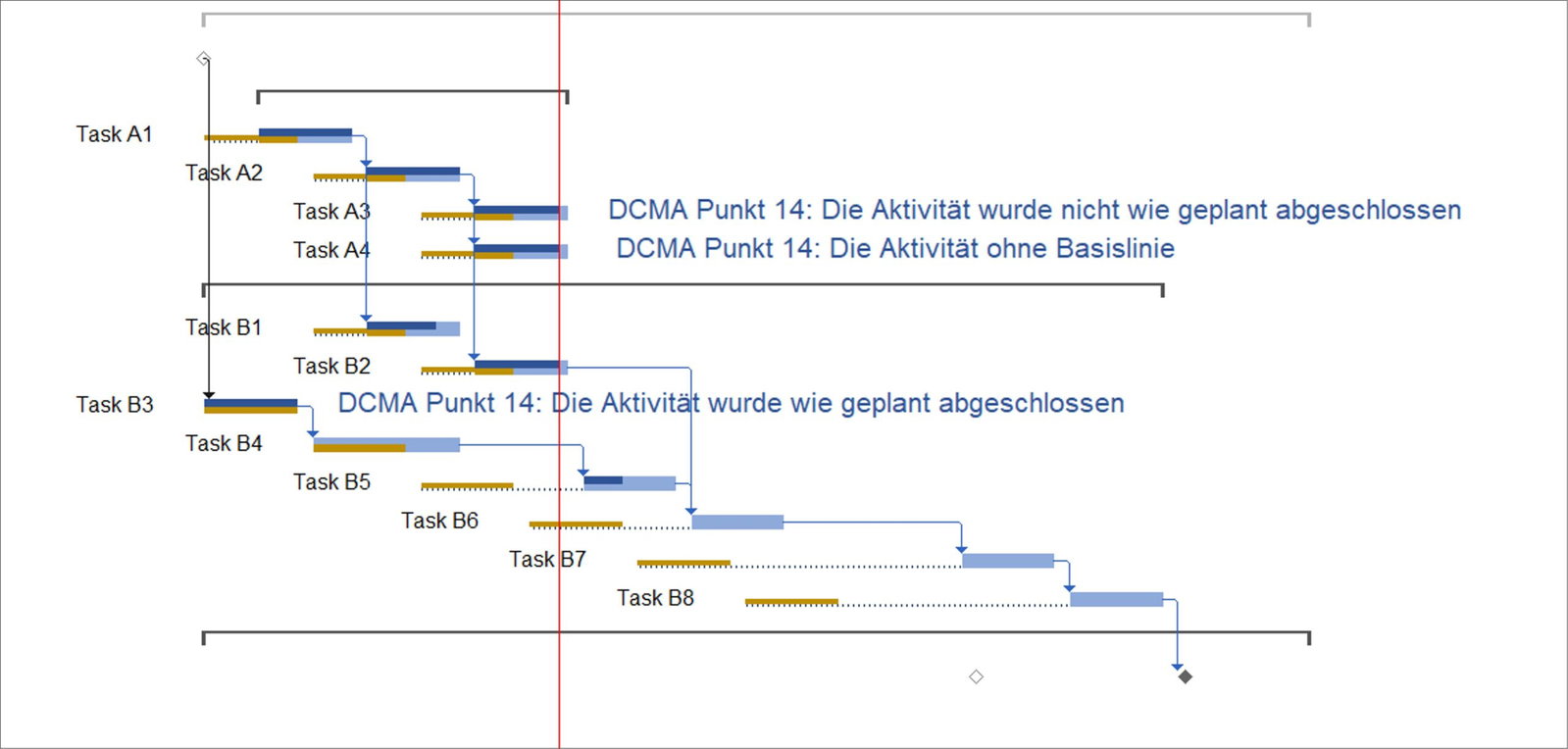
What is the DCMA 14 point analysis?
The standard was originally developed by the US Defense Contract Management Agency as part of earned value management. It was later separated from it and is now an independent standard. It assesses the condition of a schedule in terms of its structure, standardises the methodology for schedule analysis and identifies problem areas. It is also particularly useful for defining the quality requirements of project programmes.
With this standard, every project participant along the supply chain has the opportunity to improve the quality of their own schedules. This means that a well-prepared schedule that has passed the DCMA analysis can be incorporated into an integrated project schedule.
The analysis starts with the first draft schedule and can be applied at every regular schedule update to maintain quality throughout all project phases.
Based on mathematical calculations, the 14-point assessment can be performed manually or automatically using software applications or macros. Using preset thresholds, the DCMA metrics can be adjusted to achieve the required schedule quality.
The individual points are presented in detail below.
1. Logic:
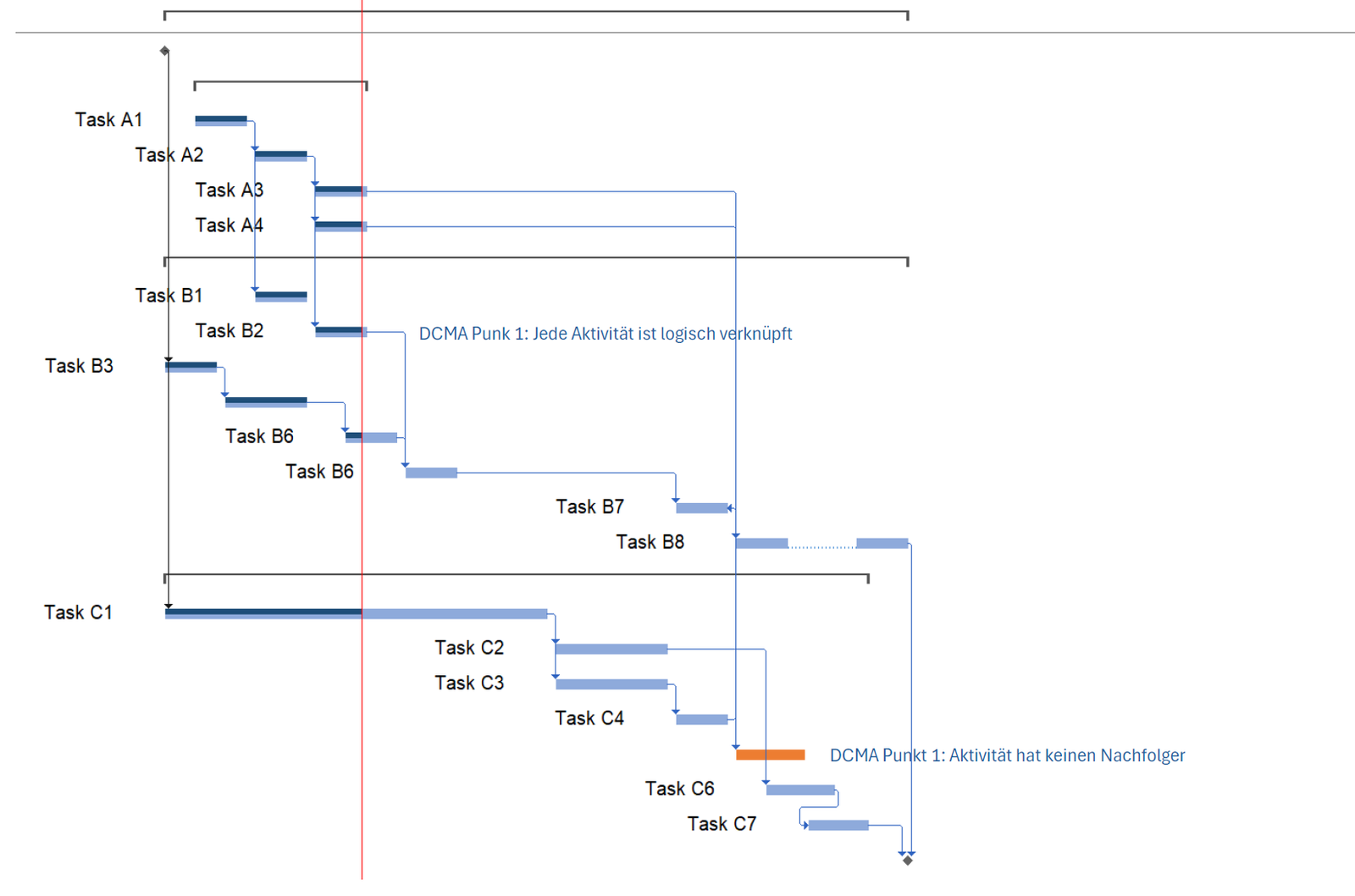
This assessment ensures that all activities are linked to predecessors and successors. Activities that lack either or both are considered scheduling errors.
Missing links have a significant impact on the project completion date, lead to incorrect schedule calculations or cause the schedule to show an incorrect critical path.
The DCMA threshold for this metric is that no more than 5 % of incomplete activities should lack a predecessor and/or successor, with the exception of start/finish milestones and summary bars.
2. Leads:
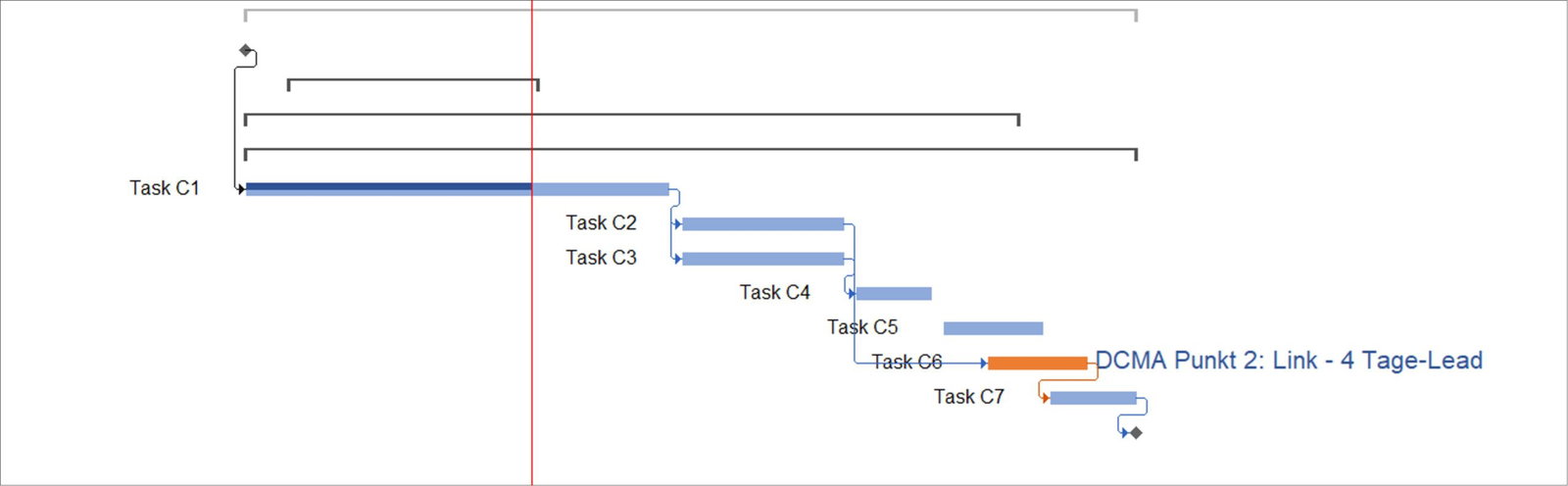
A lead is a period between two activities in which an activity starts a few days before the finish date of its predecessor. This means that it can start before its predecessor has finished.
The use of leads can have a negative impact on the overall schedule and the critical path, as they affect resource requirements, delivery dates, etc.
One option for eliminating a lead is to break the activities down in more detail so that the relationships can be shown without leads.
The DCMA threshold for this metric is zero.
3. Lags:
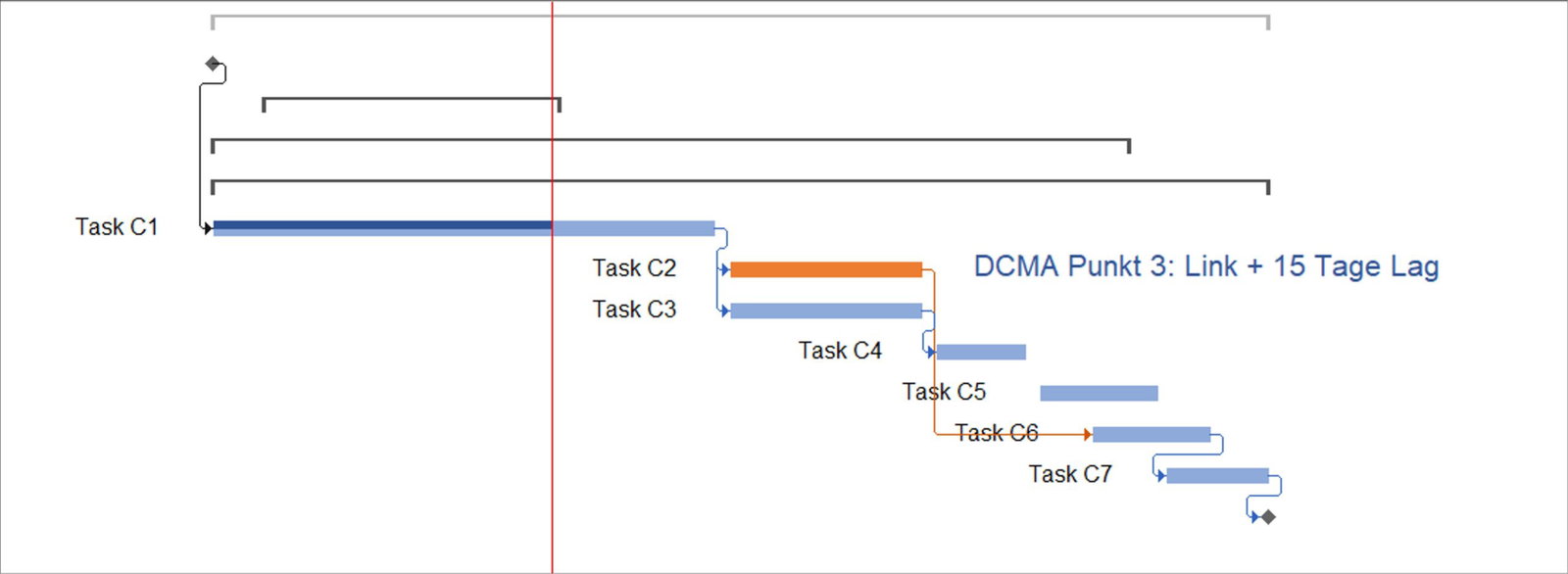
Lags occur when an activity starts a few days after the finish date of its predecessor.
They can also have a negative impact on critical path analysis and can be confusing if the reason for their use is not explained.
Lags are sometimes wrongly used to add contingency to a schedule. One option for eliminating a lag is to replace it with a separate activity.
DCMA is more flexible with this metric, with a threshold of 5 % of all relationships.
4. Relationship types:
This metric counts the existing relationships.
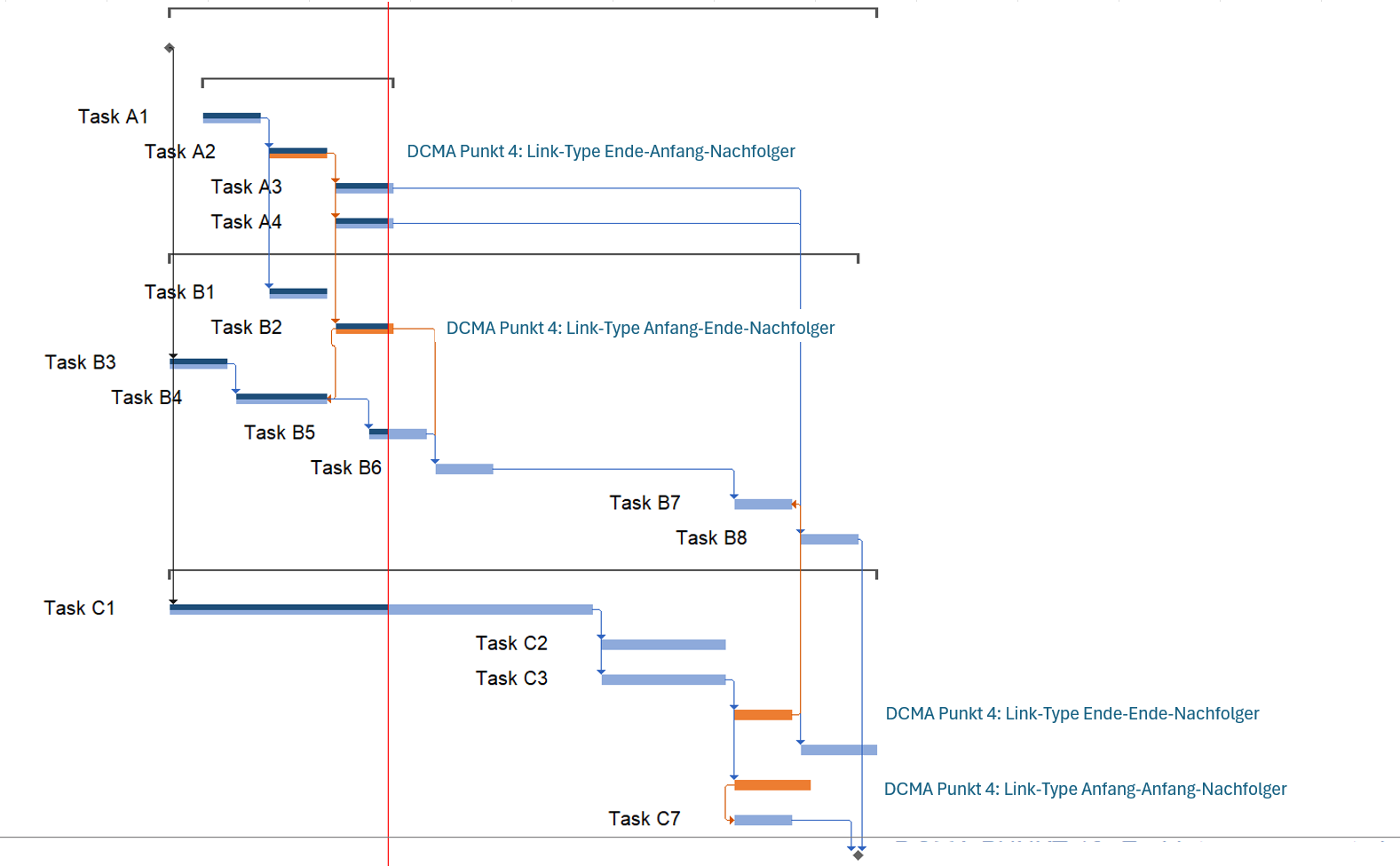
The preferred relationship between activities is finish-to-start (FS): once the predecessor has finished, the successor can start. This provides a logical path through the schedule and should make up at least 90 % of the relationship types used. FS relationships give clearer critical paths.
Start-to-start (SS), start-to-finish (SF) and finish-to-finish (FF) relationships should be avoided.
Relationships should not be used to schedule activities that do not depend on each other.
The DCMA goal is to ensure that at least 90 % of all relationships are finish-to-start.
5. Hard constraints:
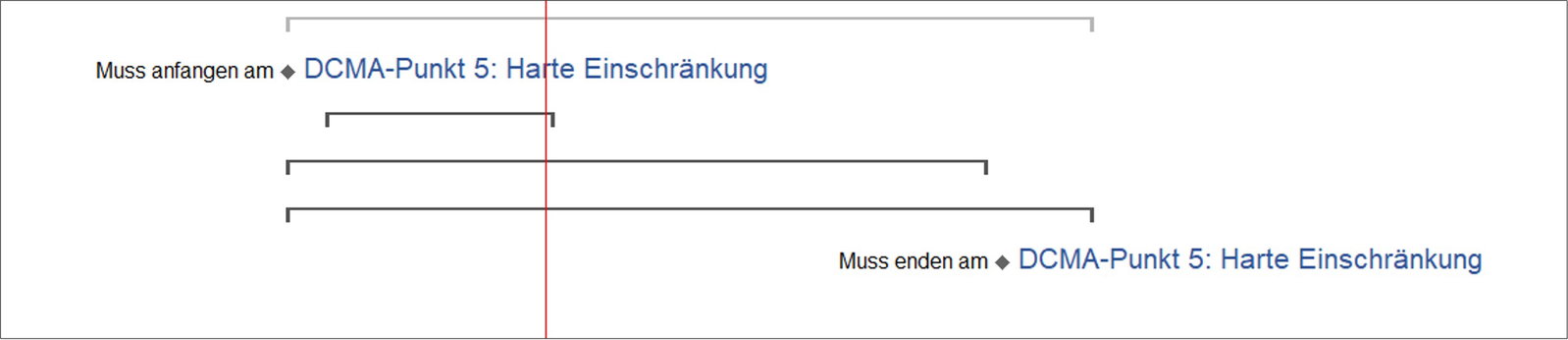
Hard constraints are constraints such as "Start No Later Than", "Finish No Later Than", "Must Start On" and "Must Finish On". They prevent activities from moving in line with their dependencies, which stops the schedule from being driven by its logic.
They distort the risk assessment and lead to questionable results. Hard constraints can also hide the critical path of the schedule and the impact of delayed activities. Constraints should be used with care, and dates should result from FS relationships and activity durations.
The DCMA threshold for hard constraints is no more than 5 % of the incomplete activities in the schedule.
6. High float:
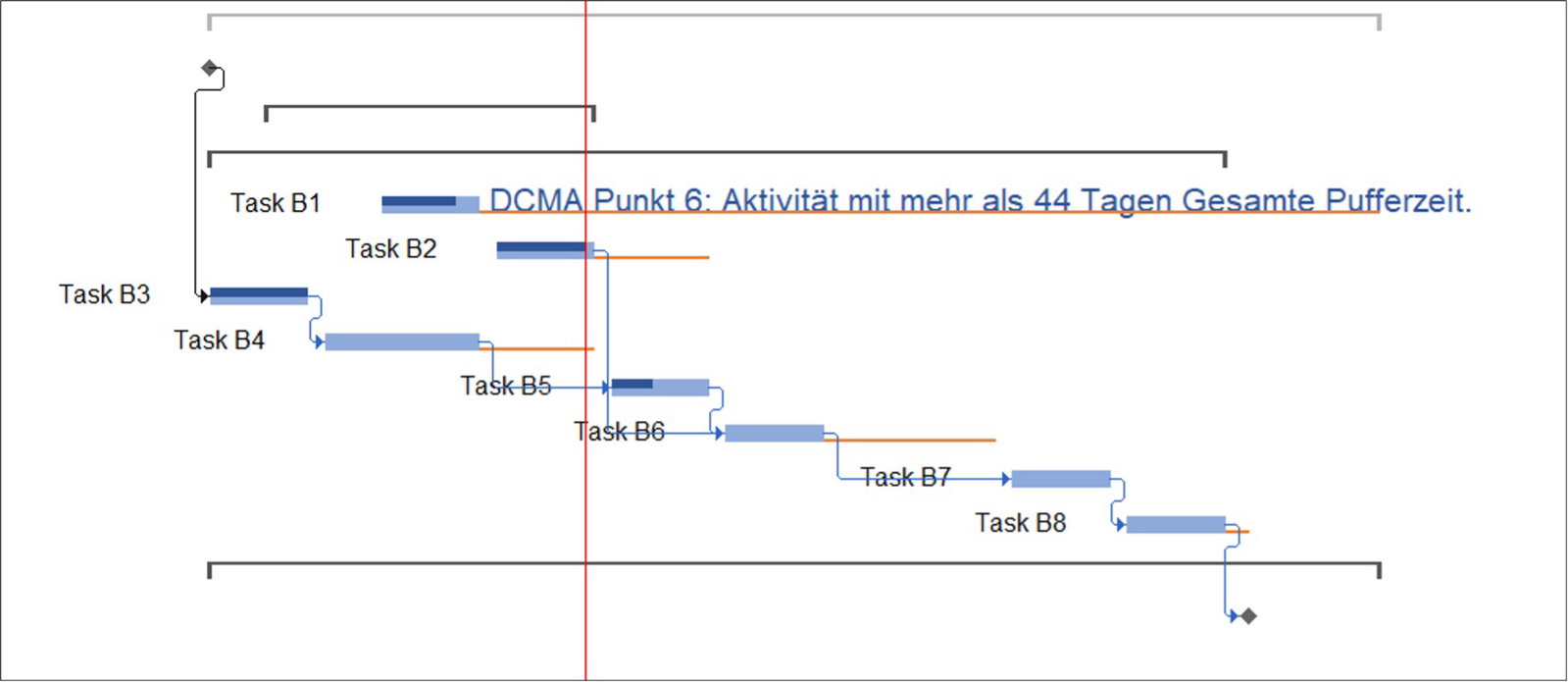
This check looks for activities with total float of more than 44 days. High float usually results from missing dependencies and has similar consequences, such as disruptions to the critical path or effects on the project completion date.
The goal is that fewer than 5 % of the incomplete activities have total float of 44 days or more.
7. Negative float:
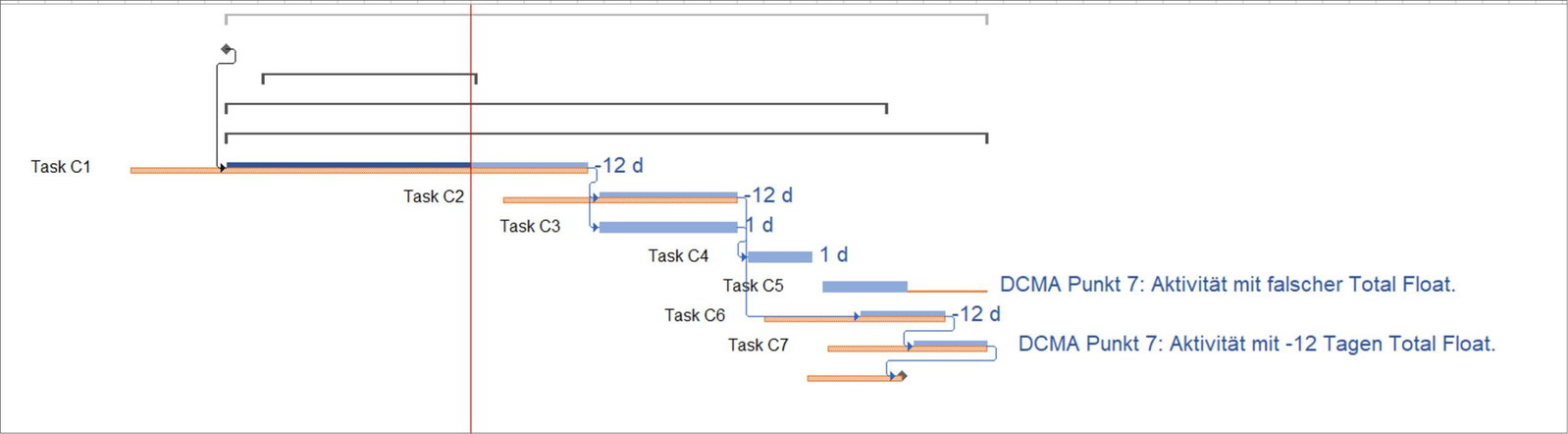
Negative float is caused by a hard constraint and is one of the more critical metrics, as it calls the validity of the schedule into question. With negative float, future key dates are likely to be missed. The assessment examines activities that delay the completion of one or more milestones.
The schedule should not contain any negative float, and all affected activities should have an explanation and a corrective action plan to resolve the negative float.
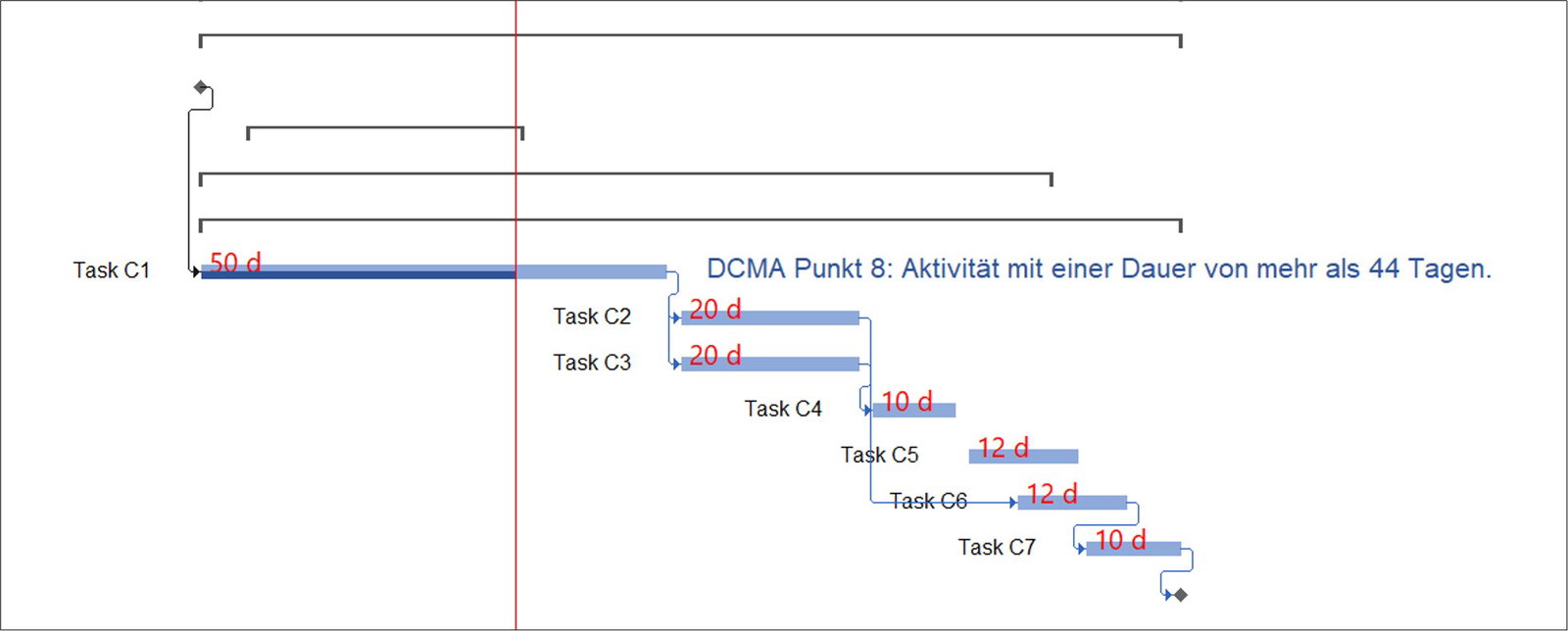
8. High duration:
Under DCMA, an activity with a high duration is one that lasts more than 44 working days.
One way of meeting this criterion is to break the activity down into individual activities that are short enough to be tracked and managed.
Activities that extend beyond this period make it difficult to plan resources and assess progress.
For activities with a long duration, there should be a strategy for measuring progress (outside the schedule if necessary).
The DCMA threshold for high duration is 5 % of all incomplete activities.
9. Invalid dates:
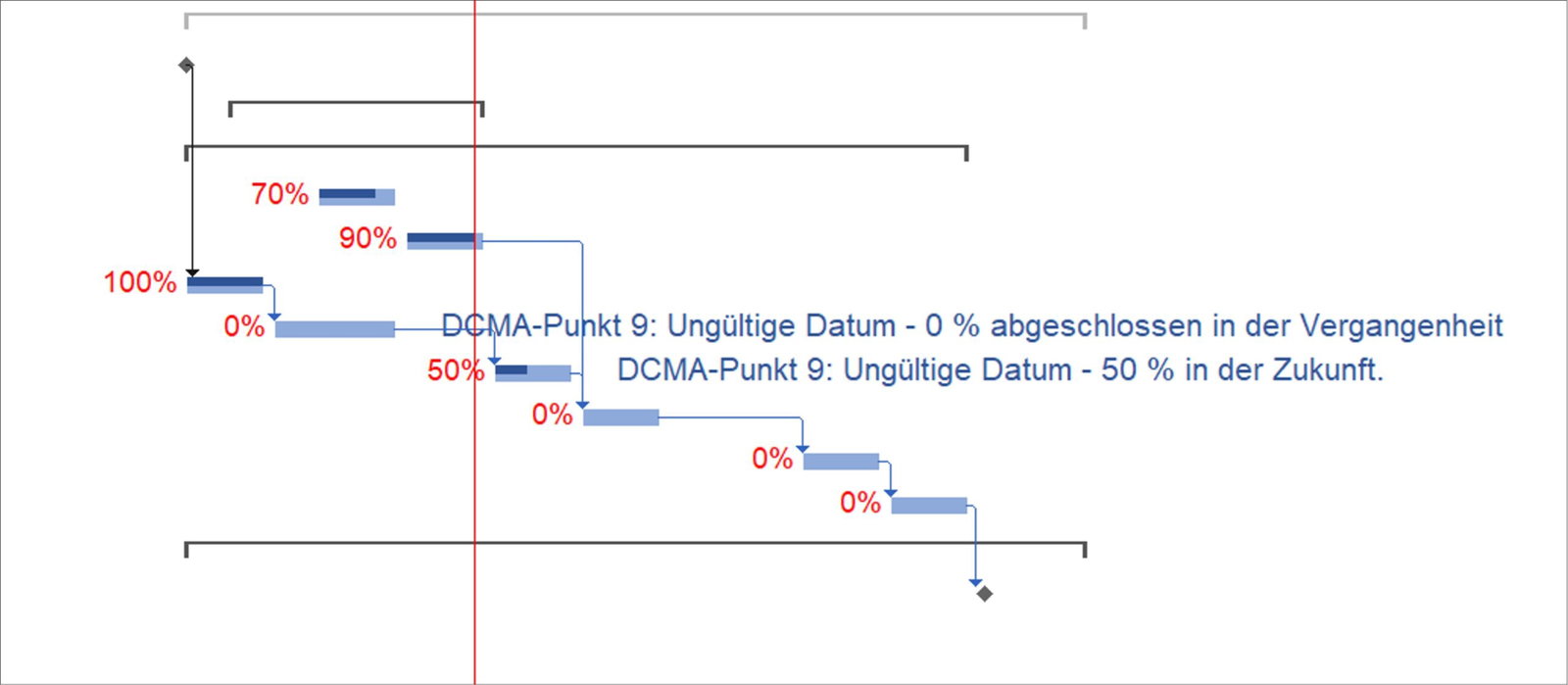
This check applies once the project has started.
Forecast dates of incomplete activities that lie in the past and actual dates that lie in the future are invalid dates; the project status date is used as the reference.
Activities that have not started should lie after the status date, and activities that have started or finished early must be recorded with actual start/finish dates. Project progress and the forecast must be reviewed and adjusted regularly.
The threshold for this metric is zero.
10. Resources:
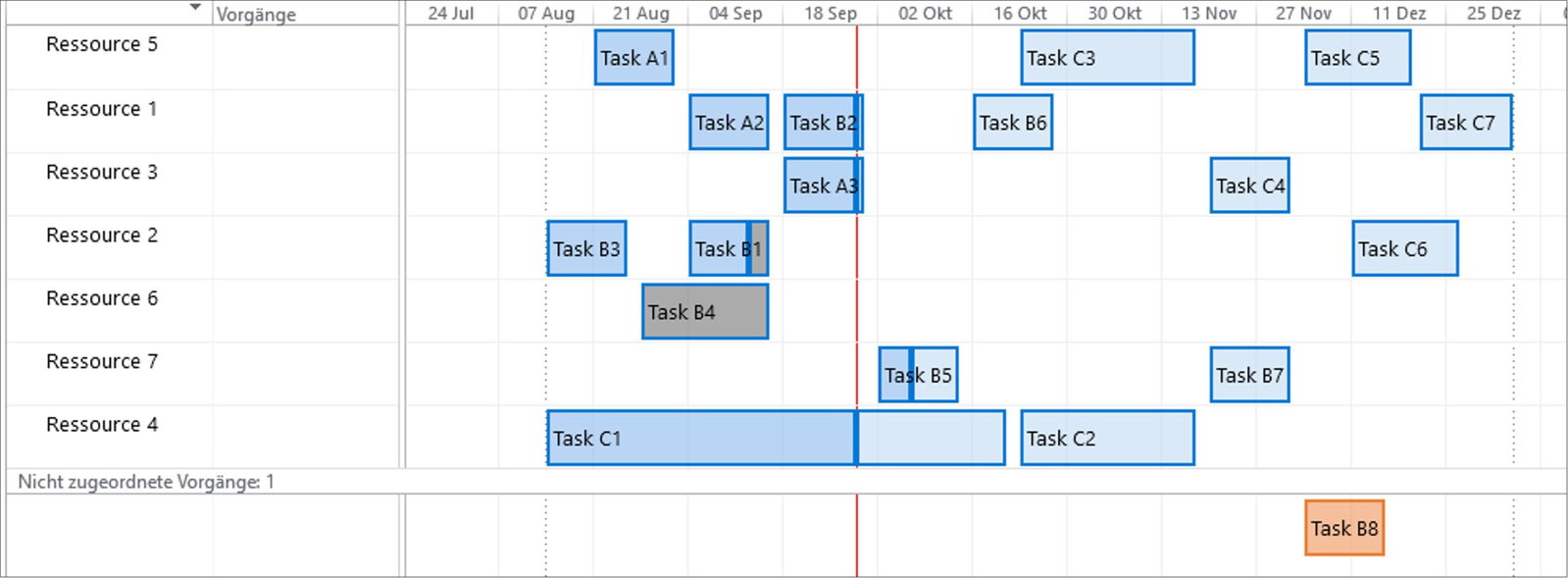
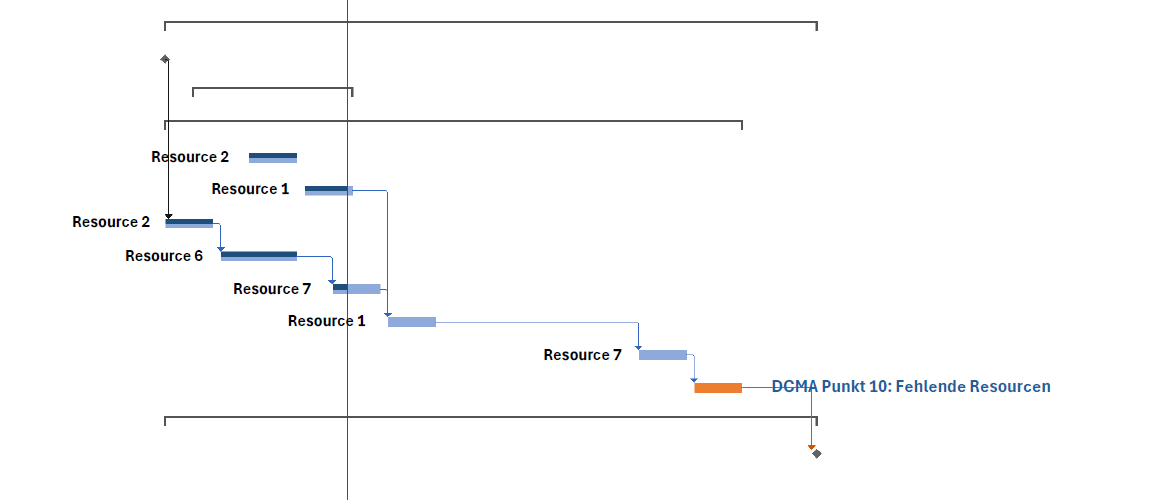
All schedule activities should have costs or resources assigned. If the schedule is not resource-loaded, problems such as over- or under-allocation cannot be identified. This applies to all activities except summary tasks and milestones. Resources should have a clear breakdown by resource type.
If resources in the schedule are over-allocated, there should be a clear resource management strategy in which resource requirements and availability can be analysed to manage efficiency.
The standard for resource assignment is 100 %
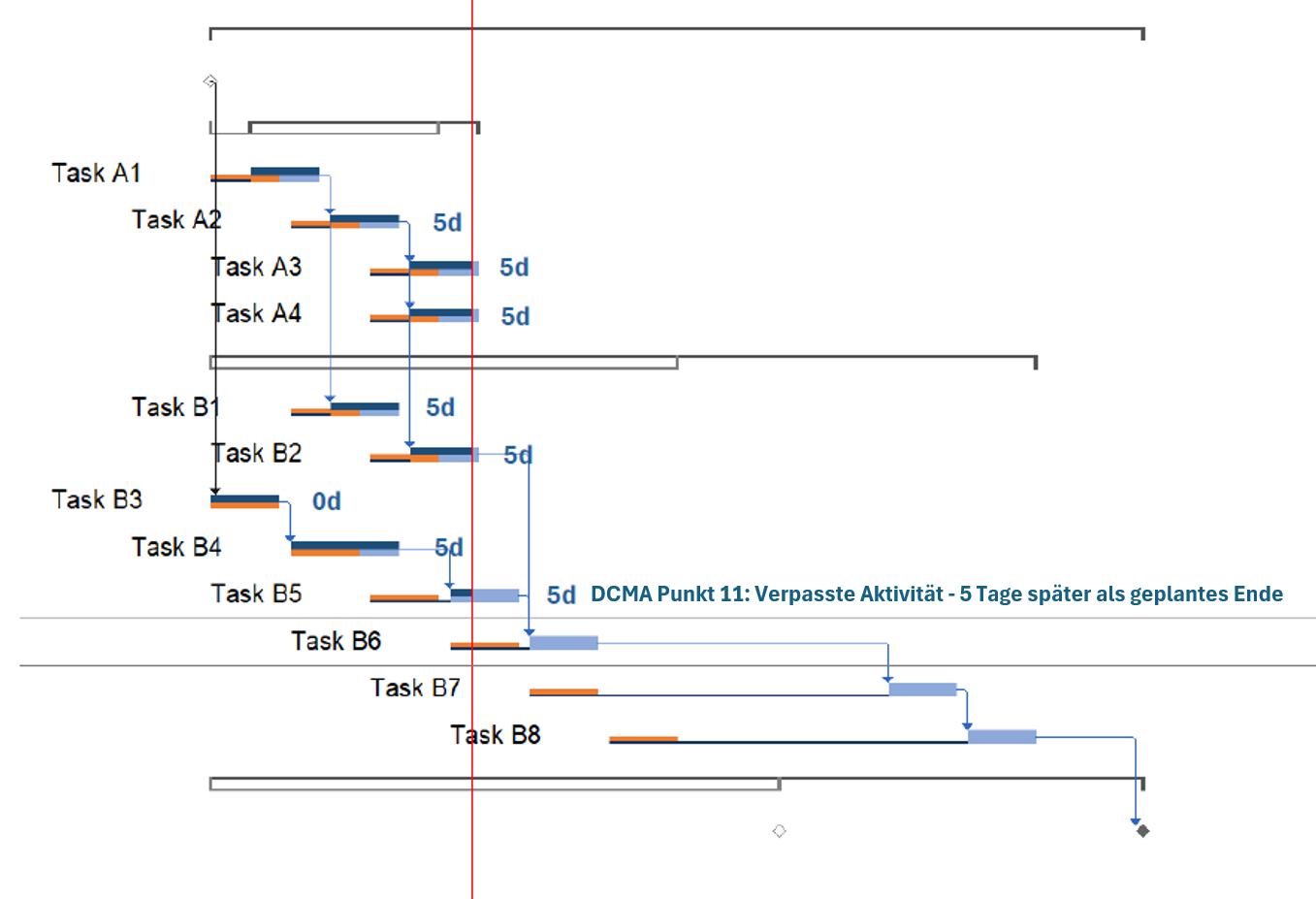
11. Missed activities:
The missed activities assessment shows how the schedule is performing against the baseline. It considers only the activities whose baseline finish date is on or before the status date and calculates the percentage of those activities that finished later than their baseline finish date.
The DCMA threshold for missed activities is 5 % of the scheduled activities.
12. Critical path test:
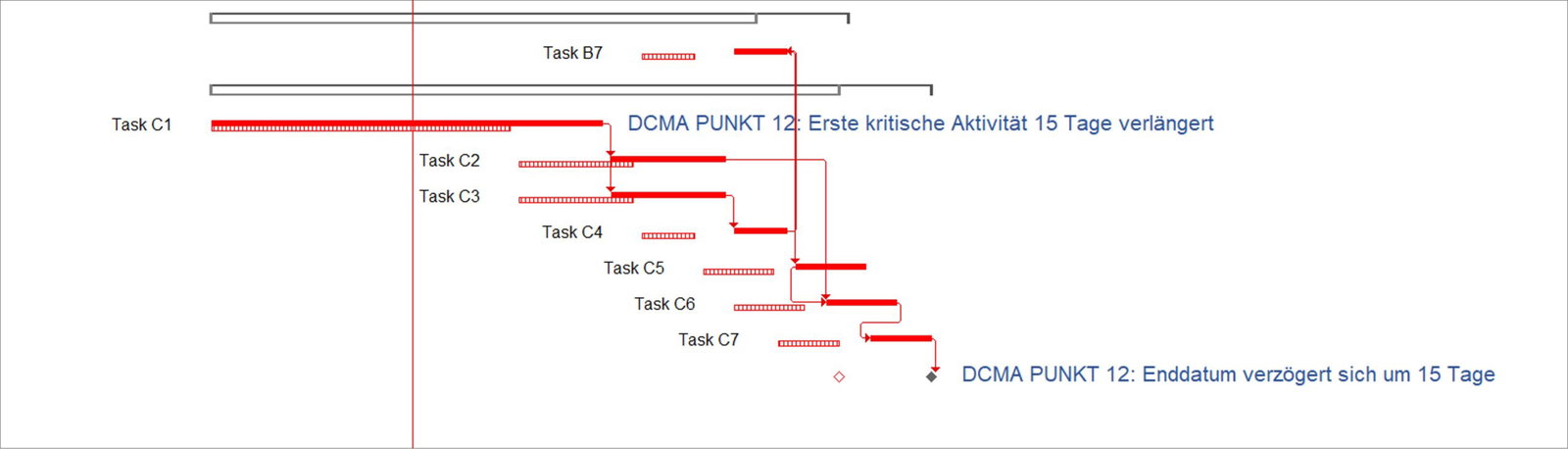
The critical path test assesses the integrity of the schedule logic by identifying the critical path and extending the duration of the first activity on it. This is a manually performed test. To pass, the finish milestone must slip by exactly the added duration.
13. Critical Path Length Index:
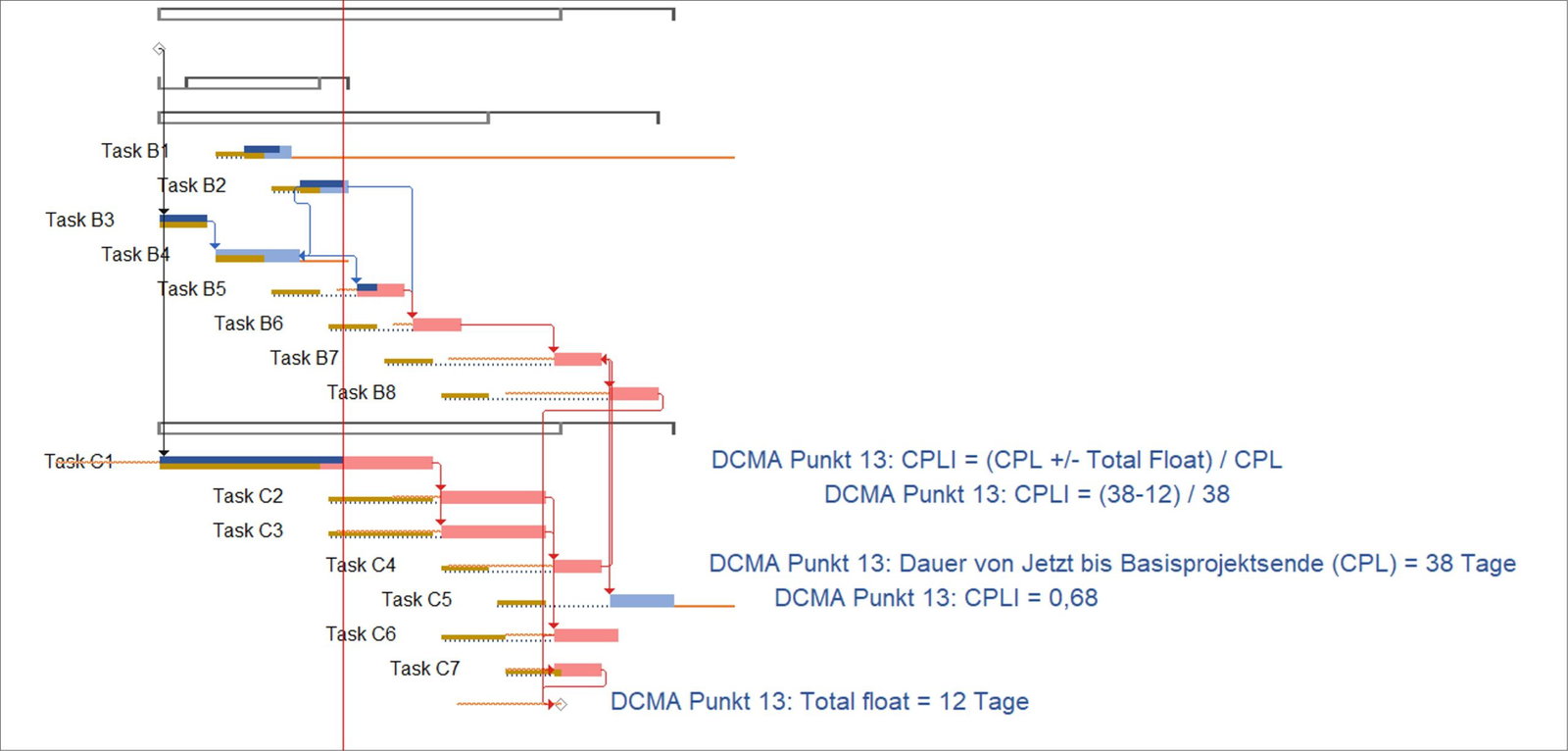
The Critical Path Length Index (CPLI) measures how realistic the planned finish date is in relation to the baseline finish date.
It is the duration from the status date to the baseline finish date plus/minus the lowest total float on the critical path, divided by the same duration without the total float.
CPLI = (CPL +/- Total Float) / CPLA CPLI of 1 means that the project will meet its finish date. A CPLI above 1 means that there is still room for manoeuvre, and a CPLI below 1 means that the team must outperform its plan in order to meet the planned finish date.
DCMA sets a CPLI target of above 0.95.
14. Baseline Execution Index:
The Baseline Execution Index (BEI) measures the number of activities completed on or before their baseline finish date and also shows the number of activities without a baseline.
The BEI divides the total number of completed activities by the sum of the activities without a baseline date and the activities with a baseline finish date on or before the current reporting period (status date).
A BEI of 1.00 indicates that the project team is keeping to the plan.